

Frank Igwealor launches trading book focused on risk control
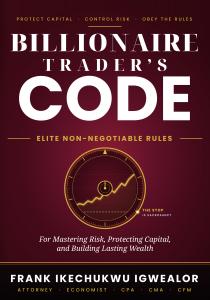
Attorney and CPA Frank Ikechukwu Igwealor has released Billionaire Trader’s Code in eBook, print and audiobook formats, with Amazon carrying the written editions and ElevenReader offering audio. The book argues that traders win by controlling risk, preserving capital and following a rule-based process, not by predicting every market move.
Why it matters: - The book targets traders who want a repeatable process for protecting capital, limiting losses and surviving long enough to benefit from any edge. - Igwealor frames capital preservation as the first requirement for trading success, not an afterthought. - The release arrives as a multi-format guide for readers who want trading rules they can use before, during and after a position is placed.
What happened: - Frank Ikechukwu Igwealor launched Billionaire Trader’s Code: Elite Non-Negotiable Rules for Mastering Risk, Protecting Capital, and Building Lasting Wealth on Oct. 29, 2026. - Amazon is carrying the eBook and print editions. - ElevenReader is carrying the audiobook. - The book is written for aspiring traders, experienced market participants and individuals managing their own capital.
The details: - The book spans 41 chapters and presents a rule-based operating code for trading discipline. - The core thesis is that traders cannot control market direction, but they can control position size, risk, exit rules, leverage and whether to stay in cash. - The manuscript rejects forecasts, hot-stock lists and single-pattern trading as the center of a professional approach. - It treats trading capital like a business’s operating inventory, where losses, commissions, spreads, financing costs and taxes all matter. - The book emphasizes positive expectancy after costs, realistic sizing, reliable execution and the ability to absorb setbacks without permanent damage. - A set of “non-negotiable commandments” includes: “Stop-losses are sacrosanct,” “Don’t fight the Fed,” “Averaging down is for losers,” “Cut losers; let winners run,” “Never fight the tape,” “No edge, no trade,” and “Never revenge-trade.” - The book also says no position should be large enough to end a trading career, and cash is a valid position when no attractive opportunities exist. - Risk-management chapters cover position sizing, stop placement, reward-to-risk asymmetry, portfolio concentration, correlation, leverage, liquidity, counterparty exposure, drawdown limits and stress testing. - The book argues for daily and weekly loss limits, graduated drawdown responses and predefined triggers to reduce exposure or stop trading. - Strategy sections cover trading styles, time horizons, major strategy families, building a repeatable edge, and writing a trading plan. - The book also addresses market structure, technical and quantitative tools, execution costs, liquidity and event risk around economic announcements. - Readers are urged to define the setup, trigger, invalidation point, expected reward and conditions for staying out of the market. - Journaling and performance measurement are presented as tools for testing whether a method works across a meaningful sample. - The manuscript includes psychology topics such as fear, greed, overconfidence, impatience, loss aversion and revenge trading. - The author uses hedge funds and family offices to show how documented mandates, explicit limits, governance and review processes can help protect capital. - The back matter includes a one-page rulebook, position-sizing and risk formulas, templates, key ratios, sample institutional rules, case studies, a reading list, a glossary and references. - The book is also positioned as educational material, not individualized investment, legal, accounting or tax advice. - The Amazon listing is available at the book’s Amazon page.
Between the lines: - The book pushes against a popular trading fantasy: that skill is mainly about predicting prices correctly. - Its institutional framing suggests Igwealor wants individual traders to adopt the same discipline, documentation and accountability used by professional money managers. - The heavy emphasis on rules, journaling and drawdown controls signals a focus on survival first, returns second. - The inclusion of cases like Long-Term Capital Management and Barings Bank underscores the book’s warning that sophisticated strategies can still fail when leverage and governance break down.
What's next: - Readers can buy the eBook and print editions through Amazon and the audiobook through ElevenReader. - Publication details, pricing and regional availability should be checked on the platform listings. - Traders using the book are expected to translate its rules into a personal trading process rather than treat it as a shortcut to guaranteed profits.
The bottom line: - Billionaire Trader’s Code is a risk-first trading manual that argues capital preservation, not prediction, is the foundation of lasting market success.
Disclaimer: This article was produced by AGP Wire with the assistance of artificial intelligence based on original source content and has been refined to improve clarity, structure, and readability. This content is provided on an “as is” basis. While care has been taken in its preparation, it may contain inaccuracies or omissions, and readers should consult the original source and independently verify key information where appropriate. This content is for informational purposes only and does not constitute legal, financial, investment, or other professional advice.
Sign up for:
Page Turner Review
The daily local news briefing you can trust. Every day. Subscribe now.
Check Your Email!
We sent a one-time activation link to: .
Confirm it's you by clicking the email link.
If the email is not in your inbox, check spam or try again.
Welcome back!
is already signed up. Check your inbox for updates.